Business Bay Vision Tower is a notable high-rise located in the heart of Dubai’s dynamic Business Bay district. This article explores the tower’s location, architecture, uses, and significance within the urban fabric of Dubai. It highlights interesting facts, contextual data, and practical information for professionals, investors, and visitors interested in one of the city’s contemporary additions to its skyline. The text presents a balanced mix of descriptive narrative and factual context, emphasizing the tower’s role in a rapidly evolving central business district.
Location and Urban Context
The Business Bay Vision Tower stands within Business Bay, a major mixed-use development planned as Dubai’s answer to modern central business districts. Business Bay sits adjacent to downtown Dubai, near iconic landmarks such as the Burj Khalifa and Dubai Mall, and extends along the newly formed waterway system—most prominently the Business Bay Canal and the Dubai Water Canal. The tower benefits from proximity to major transport arteries, including Sheikh Zayed Road, and a growing network of metro, road, and pedestrian connections.
Business Bay was conceived to combine commercial, residential, and leisure uses in a compact urban core. Within this context, Vision Tower contributes to the district’s aim of offering premium office space, high-end residential units, and hospitality options. The immediate surroundings include a mix of modern high-rises, boutique hotels, retail outlets, landscaped promenades, and waterfront leisure spaces. This location makes Vision Tower attractive to corporate tenants seeking centrality and to residents who wish to live close to Dubai’s major business and entertainment hubs.
Design, Architecture and Materials
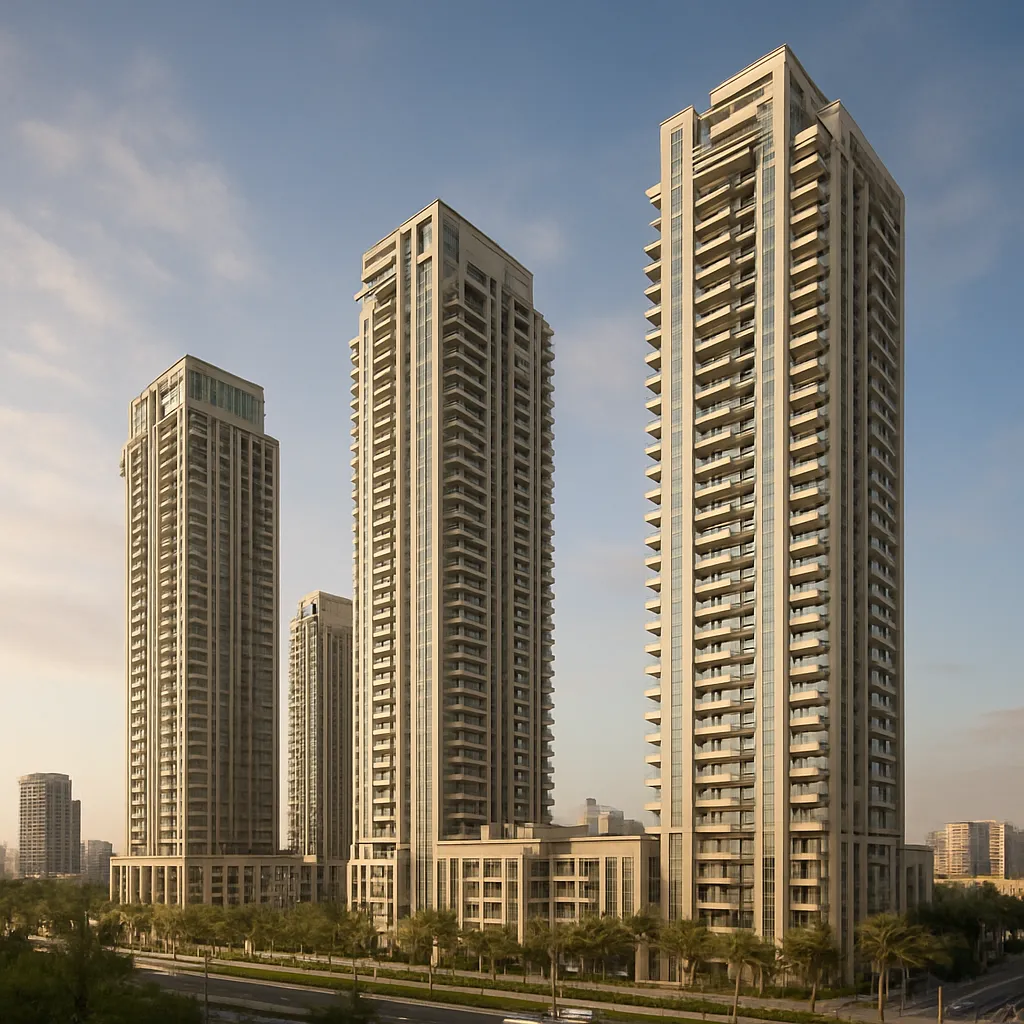
Vision Tower exhibits features typical of contemporary Dubai towers: a sleek façade, glass and metal cladding, and a composition that emphasizes verticality while incorporating design details to respond to climate and urban scale. The tower’s volumetric layout and façade treatment are designed to maximize natural light while reducing direct solar gain, using setbacks, shading elements, and high-performance glazing. These approaches reflect broader trends in Dubai architecture where aesthetics, thermal performance, and occupant comfort are balanced.
Architectural Intent and Aesthetic
The tower’s aesthetic aims to combine corporate elegance with a modern silhouette. Architects and developers often seek to produce a visual identity that reads well both at street level and within long-distance skyline views. Vision Tower’s profile is intended to contribute a refined vertical counterpoint to the clustered skyline of Business Bay, offering a recognizable landmark for the district. Key design objectives typically include:
- Maximizing usable floor area and flexibility for office and residential layouts.
- Creating an iconic façade that reads well during day and night.
- Integrating podium-level retail and accessible public spaces to activate the streetscape.
- Employing materials and systems that improve energy performance and occupant comfort.
Materials and Structural Considerations
Typical high-rise construction practices in Business Bay use reinforced concrete cores and framed structures with curtain wall façades. Vision Tower likely follows these norms, using durable finishes, engineered glazing, and mechanical systems sized for Dubai’s climatic conditions. The building envelope is designed to meet local codes for thermal insulation, fire safety, and wind loads, while internal systems address cooling, ventilation, and high-speed vertical transportation. Where projects emphasize sustainability, developers incorporate efficient HVAC, LED lighting, water-saving fixtures, and smart building management systems.
Function, Usage and Tenancy
Vision Tower serves a mix of uses that respond to Business Bay’s multi-functional urban plan. While some towers focus exclusively on office or residential functions, mixed-use models are common in Business Bay and allow developers to diversify revenue streams and create 24-hour activity patterns. The building typically includes:
- Office floors tailored for corporate and professional tenants, often with flexible floor plates and Grade A specifications.
- Residential units—if included—that target professionals and executives seeking proximity to the business core.
- Retail and F&B spaces at podium or street levels that serve tenants and passersby.
- Parking, back-of-house areas, and building services integrated into lower levels or basement areas.
Tenants in such towers tend to include regional headquarters, law firms, financial services, technology companies, and consultancies. The blend of uses contributes to a steady daytime population and supports evening activity through restaurants and leisure outlets.
Statistics, Scale and Performance (Indicative)
Precise data for Vision Tower—such as exact height, number of floors, and total floor area—can vary by source and project phase. Where official figures are available, they provide clarity for investors and occupiers; where they are not, industry observers use approximate values based on typologies in Business Bay. Indicative metrics for towers of Vision Tower’s scale in Business Bay generally include:
- Height range: typically from around 100 meters to over 200 meters, depending on the number of floors and architectural crown features.
- Floor count: commonly between 20 and 50 storeys for mid-to-high-rise buildings in the area.
- Total gross floor area: often several tens of thousands of square meters, supporting a mix of office and residential uses.
- Parking provision: designed to meet Dubai municipality standards and tenant needs, often with multiple basement levels or podium parking.
If specific statistics are needed—such as exact gross leasable area, exact year of completion, or confirmed number of units and tenants—consulting a developer brochure, municipal building records, or commercial real estate listings will provide verified values. Nevertheless, the indicative ranges above reflect the typical scale of vision-oriented projects within Business Bay’s urban grain.
Economic and Strategic Significance
Vision Tower is part of a broader strategy to promote Business Bay as Dubai’s primary central business district. Its presence supports several strategic economic functions:
- Attracting global and regional businesses seeking centrally located office space with modern amenities.
- Increasing the supply of premium residential units close to employment centers, reducing commute demand.
- Supporting retail and hospitality sectors by generating consistent footfall throughout the day.
- Enhancing investor confidence in Business Bay as a long-term, high-growth urban precinct.
Business Bay’s positioning—close to international transport links, free zones, and government services—makes buildings like Vision Tower integral to Dubai’s economic diversification efforts. Investors and occupiers view such towers as strategic assets that combine accessibility, prestige, and potential for capital appreciation.
Transport Connectivity and Accessibility
One of Business Bay’s strengths is its transport connectivity. Vision Tower benefits from multiple modes of access:
- Road: Direct access to major highways such as Sheikh Zayed Road and Al Khail Road, facilitating car-based commutes and logistics.
- Public Transport: Proximity to metro stations on the Red Line (depending on the tower’s precise location) and to an expanding bus network.
- Water Transport: The Business Bay Canal and Dubai Water Canal enable scenic waterfront promenades and potential future water taxi services.
- Pedestrian Infrastructure: Ongoing improvements to sidewalks, crossings, and pocket parks make short walks to nearby attractions feasible.
Parking and drop-off areas are planned to accommodate business users and residents. For international connectivity, Dubai International Airport and Al Maktoum International Airport are within convenient driving distances, supporting both corporate travel and tourism.
Sustainability and Building Performance
Environmental performance is increasingly important for new towers in Dubai. While specific certifications for Vision Tower would need to be confirmed, buildings of its class commonly pursue sustainability measures that include:
- High-performance glazing and insulated façades to reduce solar heat gain.
- Energy-efficient HVAC and lighting systems, often controlled through building automation for optimized consumption.
- Water-saving fixtures, efficient irrigation for landscaping, and recycling programs where applicable.
- Waste management plans and occupant awareness programs to reduce operational environmental impact.
Developers often aim for ratings such as LEED, BREEAM, or local green building certifications. These credentials enhance marketability and reduce long-term operating costs by improving energy and water efficiency.
Interesting Facts and Observations
- Strategic Naming: The “Vision” name is often used for buildings that aim to embody forward-looking business ambitions and a progressive corporate identity.
- Skyline Role: Even if not the tallest building in the area, Vision Tower contributes to the layered skyline of Business Bay, which alternates slender high-rises and broader podiums for visual diversity.
- Waterfront Appeal: Towers that face the canal enjoy premium views, higher rental yields, and elevated demand from tenants seeking a water-facing address.
- Flexible Floors: Many towers in the district offer adaptable floor plates to attract an array of tenant sizes—from single-floor occupiers to multi-floor corporate headquarters.
- Evening Activation: Mixed-use projects help foster a nightlife in Business Bay by retaining residents and bringing in restaurants and cafés that stay open after office hours.
Practical Information for Occupiers and Visitors
For companies and individuals considering Vision Tower, the following practical aspects are typically important:
- Leasing: Office space is marketed with emphasis on fit-out flexibility, access to digital infrastructure, and on-site services such as reception, security, and maintenance.
- Residents: If residential units are part of the scheme, they are advertised with amenities such as fitness centers, swimming pools, and concierge services.
- Retail and Dining: Ground-level retail is designed to serve both the building’s users and the wider neighborhood, including cafés, convenience retail, and occasional fine-dining outlets.
- Security and Access Control: Modern towers employ electronic access control, CCTV, and managed entry points to ensure occupant safety.
Cultural and Urban Impact
Beyond pure commercial value, Vision Tower contributes to Dubai’s cultural narrative of rapid urban transformation and cosmopolitan ambition. Towers in Business Bay reflect the emirate’s evolution from trade port to global business hub, demonstrating an urban type that blends multicultural workplaces, international residential communities, and globalized retail experiences. Such buildings also play a role in shaping public space, encouraging waterfront leisure, and inspiring further private sector investment in surrounding infrastructure.
Final Remarks
Business Bay Vision Tower represents a contemporary example of Dubai’s approach to central urban development: prioritizing mixed uses, modern architecture, and strong transport links. While precise statistics for the tower should be confirmed through official project documentation or commercial real estate listings for accuracy, the tower’s contribution to Business Bay’s vibrancy is clear. It enhances the district’s profile as a place where business, living, and leisure converge—anchoring new economic activity and supporting Dubai’s position as a major global city.