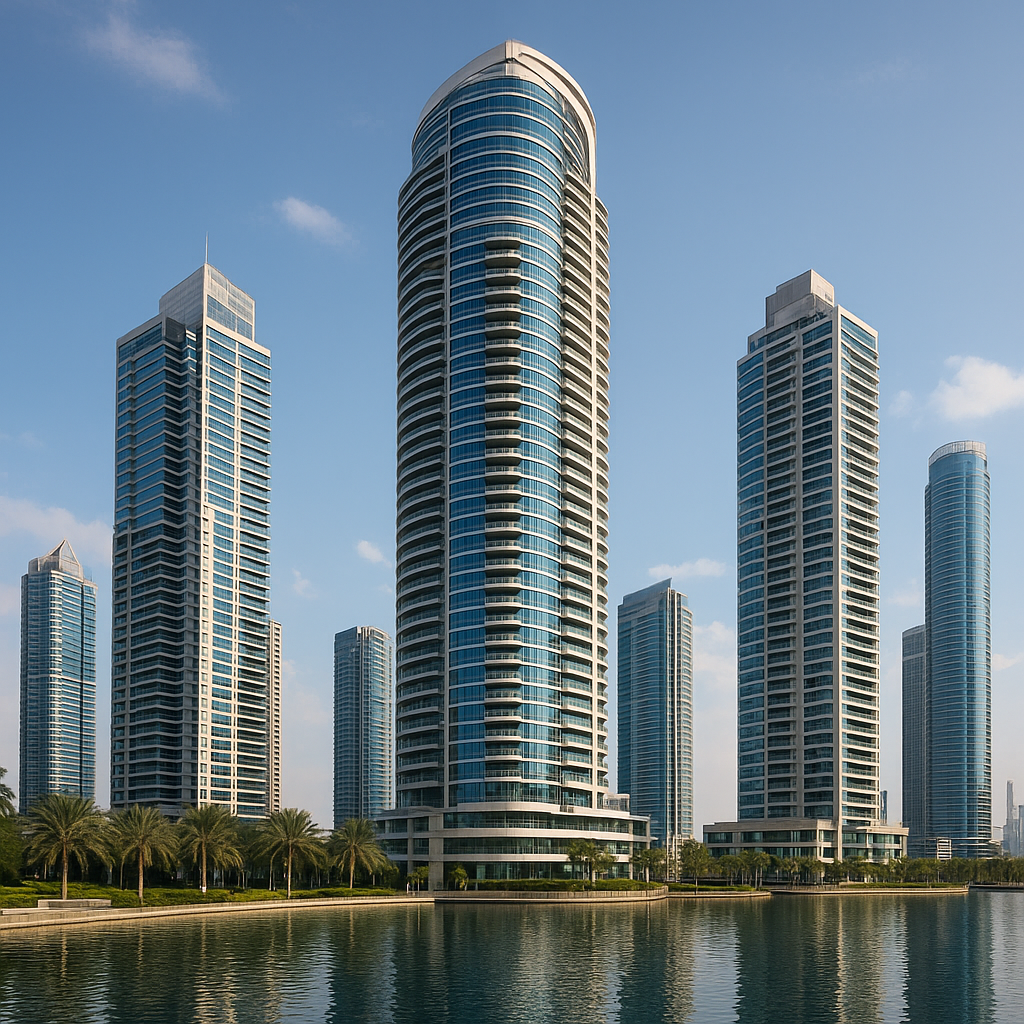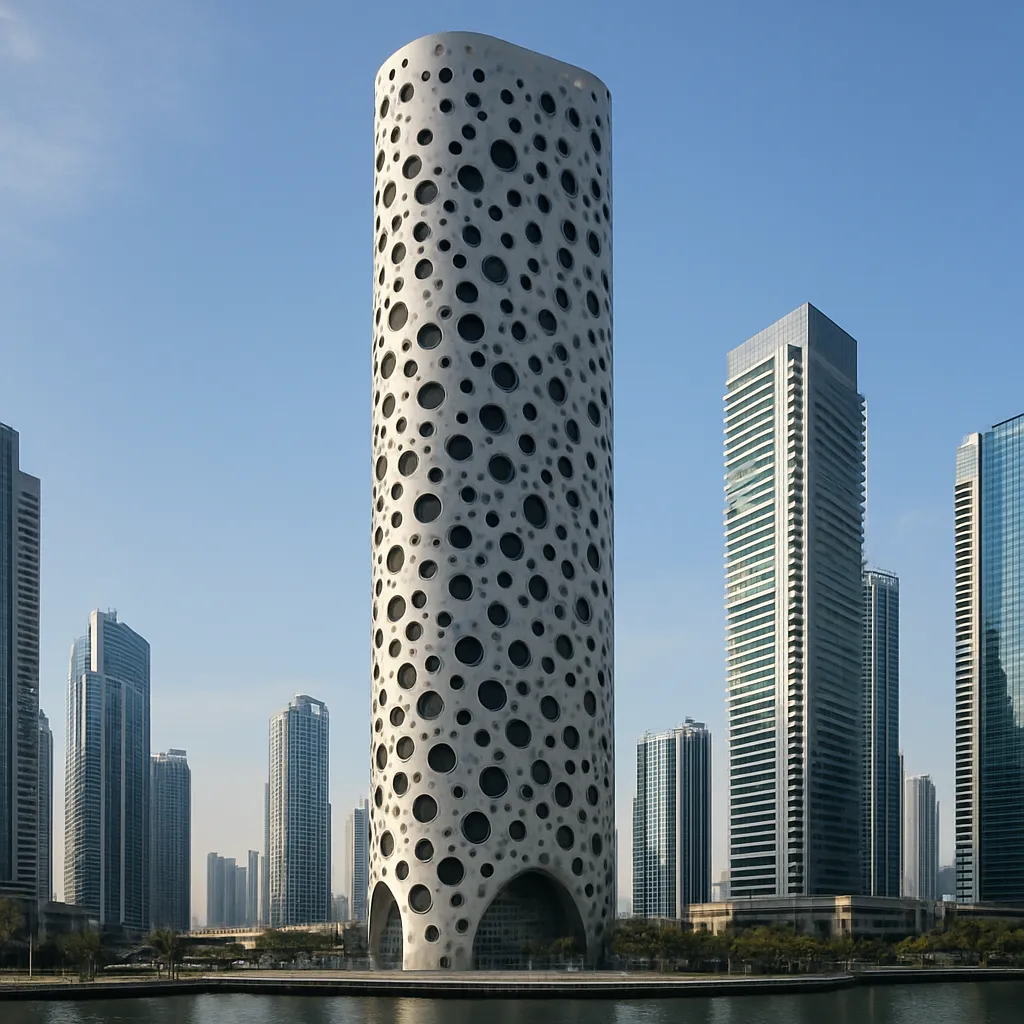
The O14 Tower, widely nicknamed the Swiss Cheese Tower, is one of Dubai’s most visually striking examples of contemporary architecture. Nestled in the developing Business Bay district, the building has attracted global attention for its distinctive perforated concrete shell — simultaneously an aesthetic statement and a high-performance environmental device. This article explores the tower’s location, design logic, structural innovation, environmental strategies, statistics that define it, and the cultural and architectural significance that make O14 an enduring point of reference in discussions about resilient high-rise design in arid climates.
Location and urban context
The O14 Tower stands in Business Bay, a rapidly evolving mixed-use corridor adjacent to Downtown Dubai. Business Bay is conceived as a central business district with a mix of office towers, residential buildings and retail spaces, and it forms a key component of Dubai’s post-2000 urban expansion. The tower occupies a prominent lot close to major thoroughfares and man-made waterways that characterize the area, contributing both to the skyline and to the district’s growing reputation as a regional business hub.
The location chosen for O14 was significant because it placed a bold experimental structure within a mainstream commercial context. The tower’s visibility from neighboring districts, and from major routes into Downtown Dubai, turned it into an emblematic project: it demonstrates that innovative, performance-driven architecture can coexist with commercial and speculative real estate developments. As Business Bay densified, O14 became a reference point in architectural tours and publications, appreciated for its daring exterior and practical responses to climate and urban conditions.
Design concept and architectural language
The architectural concept behind O14 is immediately legible: the building’s most defining feature is its continuous, perforated concrete shell that wraps the tower from base to roof. This shell performs multiple roles — it is a structural system, a sun shading device, and a visual identity. The nickname Swiss Cheese Tower stems from this pattern of circular openings that perforate the façade, creating a distinct texture and silhouette against Dubai’s skyline.
The design logic sought to reconcile aesthetic impact with environmental and structural performance. Rather than relying on a conventional glass-and-steel envelope, the design team pursued a monolithic concrete exoskeleton that would:
- Provide lateral stiffness and bracing, reducing reliance on internal columns and enabling flexible floor plates;
- Control solar gain and glare through depth and perforations in the façade;
- Allow for controlled natural ventilation and daylighting in a hot, arid climate;
- Create a memorable urban icon that would distinguish the project in a crowded skyline.
The result is an architecture that is bold and utilitarian: it reads as sculpture at a distance and reveals a thoughtful performance logic up close. Its aesthetic is almost geological — the concrete shell appears carved or weathered, and the list of circular apertures animates the surface as the sun moves, creating shifting patterns of light and shadow within the interior.
Structural and engineering innovations
At the heart of O14’s structural ingenuity is its reinforced concrete exoshell. This external skin functions as a load-bearing element, resisting wind and lateral loads while supporting the gravity loads transferred through the floor plates and core. The exoshell’s thickness and the size and pattern of the openings were carefully engineered to balance strength and porosity.
Key structural features include:
- Perforated concrete exoskeleton that functions as a continuous shear wall, increasing lateral stiffness and enabling column-free floor spans;
- Variable aperture sizes that maintain structural continuity while allowing daylight and ventilation; openings are distributed to respond to wind and sun exposures;
- Integration of the exoshell with the central core, so that the building behaves as a unified structural system under wind and seismic loads;
- Use of high-performance concrete mixes and reinforcement detailing to ensure durability given the local climatic conditions, particularly thermal stresses and potential corrosion issues in urban coastal environments.
Because the shell contributes to structural resistance, floor-to-floor planning benefits from greater flexibility. Offices within the tower often present open, column-free spaces that can be adapted for different tenant needs. The structural strategy also helps reduce the amount of interior finishing typically required to conceal a grid of columns, contributing indirectly to cost and time efficiencies during fit-out.
Environmental strategies and climate response
One of the most compelling aspects of O14 is how its form addresses the harsh climatic conditions of Dubai. The perforated façade is not merely decorative; it is an environmental strategy for shading and passive comfort. The shell reduces direct solar radiation on glazing and internal spaces, decreasing cooling loads and improving occupant comfort without a complete reliance on mechanical systems.
Important environmental measures associated with the tower include:
- Solar shading through façade depth: The concrete shell provides a buffer between direct sun and the internal glazing, lessening cooling demand;
- Daylight modulation: Apertures are designed to admit diffuse daylight deep into the floor plates while avoiding excessive glare;
- Natural ventilation potential: In certain perimeter zones, the openings can facilitate cross-ventilation strategies or help ventilate intermediate service voids, reducing reliance on continuous mechanical ventilation;
- Thermal mass benefits: The mass of the concrete shell can moderate diurnal temperature swings, storing cool overnight temperatures and contributing to a more stable internal environment.
While a fully passive building in Dubai remains a challenge, the O14 approach reduces energy intensity relative to a typical glazed corporate tower by combining form, materiality and aperture control. The tower therefore acts as an instructive case study for integrating passive strategies into high-rise office design in hot climates.
Materials, façade technology and craftsmanship
The selection of material—primarily concrete—was central to the tower’s identity and performance. The exoshell was cast in place or constructed using large precast segments; either way, the project demanded high standards of concrete craftsmanship, formwork precision and reinforcement detailing. The visible surface of the shell was intended to be a design statement, so finishing and consistency were critical.
The apertures themselves showcase a range of sizes and staggered placement, which required meticulous planning for formwork and concrete casting. The building team had to resolve technical challenges such as controlling surface cracking, ensuring uniform colour and texture, and detailing interfaces where the shell met glazing, structural anchors and service penetrations. These details matter: they determine the long-term durability and the aesthetic cohesion of the façade.
Program, amenities and interior environment
O14 is primarily an office building, with flexible floor plates that cater to corporate tenants and workspaces requiring adaptable layouts. The program typically includes:
- Column-free office floors that allow open-plan arrangements;
- Service core with elevators, stairs and utilities located centrally to maximize perimeter workspace;
- Ground-floor lobbies and retail or amenity spaces that engage the street and contribute to Business Bay’s pedestrian realm;
- Roof or terrace areas that may offer mechanical plant locations and potential occupant terraces where feasible.
Because the exoshell allows interesting light and ventilation conditions, interior environments benefit from dynamic light patterns and reduced reliance on artificial lighting during daytime. Acoustic and thermal comfort measures are typically integrated through glazing choices, insulation and HVAC design to ensure modern office standards.
Statistics and notable figures
O14’s metrics help to quantify its scale and impact. Commonly cited figures include:
- Approximate height: around 100 meters (roughly 100–110 m range reported in various sources);
- Number of floors: typically reported at about 23 floors of offices and services;
- Total gross floor area: reported estimates vary, but figures are often in the realm of several thousand square meters of office space (tens of thousands of square feet);
- Façade composition: a continuous reinforced concrete exoskeleton with hundreds of circular openings of varying diameter;
- Completion and occupancy: O14 was completed during the late 2000s to early 2010s period as part of the initial development phase of Business Bay.
Note: Exact numeric values for some statistics are represented as ranges or approximations. Data published by different sources may vary slightly, especially for gross floor area and completed floor count, so readers consulting the building for technical or legal purposes should reference official developer or municipal documentation for final, authoritative figures.
Construction timeline and project delivery
The construction process for a building like O14 demanded careful sequencing because the exoshell had to be formed and cured to precise tolerances. Typical steps included site preparation, deep foundations and pile work where needed, construction of the central core, and progressive casting or erection of the exoskeleton combined with floor-slab construction. The logistics of forming perforated façades, managing complex reinforcement, and installing services required close coordination between architects, structural engineers, contractors and specialist façade teams.
Given Dubai’s rapid development pace during the early 21st century, projects like O14 were often delivered on accelerated schedules — but not at the expense of key quality controls. The project also navigated issues typical of waterfront and desert-adjacent sites, such as chloride exposure, thermal stresses and coordination with nearby infrastructure development.
Cultural impact and architectural significance
O14’s cultural and architectural impact goes beyond its immediate function. It is frequently cited in architectural discourse as a successful example of form-driven performance, where a building’s expression clearly communicates its environmental role. The tower’s perforated skin has been photographed widely, used in textbooks and showcased in design exhibitions as an innovative response to climate and program.
Because it diverges from the glass curtain-wall typology common to many corporate towers, O14 is often discussed in relation to sustainability, material honesty and tectonic expression. Its bold silhouette prompts discussions on how architecture can be both a symbolic object and a technical system. For students and practitioners, the tower is a case study in combining structural efficiency, environmental responsiveness and memorable design language.
Public perception, nickname and branding
The affectionate nickname Swiss Cheese Tower captures the public imagination because it instantly communicates the building’s most visible trait: a pierced, textured façade. Nicknames like this do more than amuse; they help buildings enter public discourse and become landmarks in the mental maps people use to navigate and describe cities. Locals, tourists and professionals often use the nickname alongside the formal name, and the tower appears in walking tours focused on Business Bay and modern Dubai architecture.
From a branding perspective, the tower’s strong visual identity provides intrinsic marketing value to developers and tenants — a distinctive façade can be a differentiator in attracting tenants who value prestige and architectural character.
Comparisons, lessons learned and legacy
O14 can be compared with other contemporary towers that integrate exoskeletons or perforated façades, such as projects that use brise-soleil, double-skin façades or structural diagrids. What sets O14 apart is the integration of structural and environmental roles into a single, monolithic concrete element. Lessons learned from the project include:
- The value of architectural clarity: when design strategies are legible, they can communicate both purpose and identity;
- Performance-driven form-making: combining shading, massing and structure can yield measurable environmental benefits;
- Construction coordination: complex façades require early collaboration between design and construction teams to manage tolerances and long-term durability;
- Contextual creativity: in rapidly developing urban districts, innovative buildings can elevate the character of an entire district if they balance novelty with practical performance.
Visiting, viewing and photographic opportunities
O14’s striking appearance makes it a popular subject for architectural photography and urban exploration. For visitors, vantage points include nearby roads and pedestrian routes in Business Bay, where the building is visible as part of a larger urban composition. The interplay of light and shadow on the façade is especially photogenic at early morning and late afternoon, when the low sun sculpts the circular openings and reveals texture.
Because it is a working office building, interior access typically requires appointment or permission from tenants or building management. Public interaction is primarily visual: the tower is best appreciated from the outside, where its full volumetric expression can be seen against the skyline.
Conclusion
O14 — the Swiss Cheese Tower — stands as an important example of how contemporary architecture can combine sculptural form, structural innovation and environmental intent. Located in the dynamic Business Bay district of Dubai, the tower challenges the prevailing high-rise aesthetic by prioritizing a robust concrete exoskeleton that performs as both structure and climate control. Its legacy is not only a memorable silhouette on the skyline but also a practical demonstration that design can be both expressive and efficient.
Key words highlighted throughout this article emphasize the building’s identity and the primary themes associated with its design: O14 Tower, Swiss Cheese Tower, Business Bay, perforated concrete, exoskeleton, ventilation, sustainability, Reiser + Umemoto, Dubai, and office.