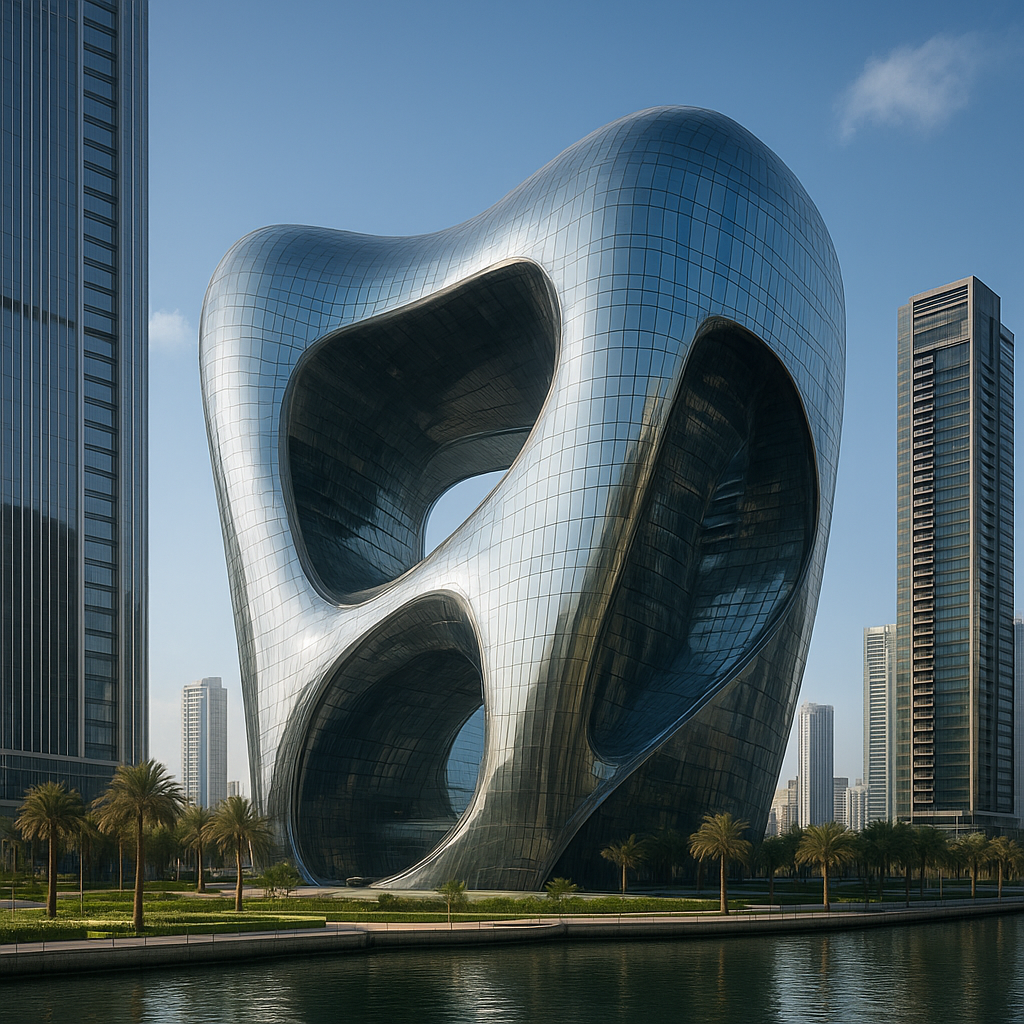
The Opus by Zaha Hadid in Business Bay, Dubai, is one of the most striking examples of contemporary architecture in the United Arab Emirates. Conceived by Zaha Hadid Architects and developed by Omniyat, the building is famous for its dramatic sculptural form, a deliberately created void at the heart of a cubic volume, which gives the tower its instantly recognizable silhouette. More than a single-purpose tower, The Opus is a mixed-use project combining commercial offices, hospitality and public spaces, and it has become a visual focal point and talking point in Dubai’s rapidly evolving Business Bay district.
Design and architectural concept
The Opus responds to Hadid’s lifelong fascination with fluid forms and the manipulation of solids and voids. From the outside, the building appears as a dark, monolithic cube punctured by a central, organically shaped opening that reveals interior spaces and frames views toward the city and the water channels of Business Bay. This dramatic void is not only a compositional gesture but also a functional atrium and social space that links the building’s programs.
The design process emphasized the continuity of floorplates and circulation paths around the central cavity, creating an interplay between enclosed and open areas. Unlike conventional orthogonal office towers, The Opus uses curved glass panels and an irregular, flowing interior to blur the boundary between interior and exterior. The building’s façade alternates between highly reflective black glass and more transparent sections, producing a dynamic visual effect that changes with light and perspective. This complex geometry required advanced computational design tools and close collaboration between architects, engineers and fabricators to transform Hadid’s conceptual language into a built reality.
Key architectural features include:
- the sculptural void that defines the building’s identity;
- free-form interior shapes and flowing circulation routes;
- a double-skin, high-performance façade with curved glazing;
- integrated public spaces and hospitality within a single volume;
- the use of parametric design and digital fabrication techniques to realize complex surfaces.
History, development and construction
The Opus was developed by Omniyat, a Dubai-based real estate investor and developer known for commissioning architecturally ambitious projects. The tower was intended to be a statement piece for the Business Bay precinct, an area planned as a commercial and residential extension of downtown Dubai. The project attracted early attention for its conceptual daring—Hadid’s design promised a “building that eats itself,” a phrase that captured public imagination and amplified media interest.
Construction of The Opus required meticulous engineering and staging. The irregular void and the cantilevered sections called for specialized structural solutions and prefabrication strategies. Building such a complex geometry involved close coordination between structural engineers, façade consultants and construction managers to ensure both aesthetic integrity and safety. Advanced digital tools were used to model the façade panels and design bespoke curtain wall components. The result is a seamless expression of form where the envelope and interior surfaces follow continuous geometric logic.
While precise project timelines can vary in reporting, The Opus was completed and made publicly accessible in the late 2010s, becoming one of the headline architectural achievements of that period in Dubai. The building’s completion coincided with a wave of iconic constructions in the city, yet it remains uniquely associated with Hadid’s formal approach rather than simply with scale or height.
Function, program and interior spaces
The Opus is a mixed-use building combining premium office space with luxury hospitality and public amenities. Rather than treating the programmatic elements as separate blocks, the design integrates them around the central void to encourage interaction and to provide dramatic interior views. The void functions as a social nucleus: a public-facing atrium that introduces natural light deep into the building while offering views across multiple levels.
Hospitality plays a significant role in The Opus. The building has hosted a boutique luxury hotel and related facilities, bringing an urban-lifestyle element to the tower. In the hotel and hospitality areas, interior design complements Hadid’s external language: flowing lines, bespoke furniture, and sweeping surfaces create immersive spatial experiences. Office tenants benefit from the building’s premium finish and the prestige associated with a signature Hadid project, along with flexible floorplates that accommodate contemporary workplace requirements.
Circulation is designed to be experiential. Elevators and staircases are positioned to maximize engagement with the central void, and communal terraces and café areas capitalize on dramatic internal and external vistas. The architectural ambition was to create a five-sense experience: visual drama, acoustic considerations, tactility of materials, and a sequence of spatial reveals as visitors move through the building.
Materials, technology and sustainability considerations
Realizing the building’s complex geometry demanded sophisticated materials and construction technologies. Curved glass panels, customized metalwork and precision-engineered structural elements were necessary to achieve the continuous surfaces that define the Opus. The façade system uses high-performance glazing to reduce solar heat gain—a vital feature in Dubai’s hot climate—while offering views and daylighting to interior spaces.
Sustainability measures focus on energy efficiency and occupant comfort. While The Opus is primarily celebrated for its sculptural form, its designers also incorporated climate-responsive elements: optimized glazing ratios, efficient HVAC systems and LED lighting reduce operational energy use relative to older-generation towers. The integration of shaded terraces and internal overhangs mitigates direct sun exposure. Additionally, the building’s compact, mixed-use program contributes to reduced travel emissions for occupants who can combine work, leisure and accommodation in a single location.
Statistics and measurable data
Some of the publicly discussed statistics and physical attributes associated with The Opus include its status as a mid-rise, high-profile structure within Business Bay. It is often described in terms of floor count, size and program mix rather than extreme height. The project provides a combination of high-specification office space and luxury hotel accommodation. Specific figures cited in various industry sources include approximate floor counts in the low double-digits and a total gross floor area suitable for a mixed-use tower of its footprint. Exact numeric specifications may vary between sources, but the building’s significance is less about record-breaking height than about its architectural innovation and formal boldness.
For readers seeking precise technical data (floor area, heights in meters, number of hotel rooms or leasable office floors), developers’ or architects’ official publications and planning submissions are the most reliable sources. Many industry summaries highlight:
- the building’s defining void and central atrium;
- its mixed-use program combining hospitality and office space;
- the use of bespoke façade engineering and curved glazing;
- completion and opening in the latter half of the 2010s (circa 2018).
Cultural impact, reception and awards
The Opus generated immediate international interest because of its author—Zaha Hadid, a Pritzker Prize–winning architect whose built work frequently commands global attention—and because the project turned a bold conceptual idea into a concrete presence in Dubai’s skyline. Critics and commentators praised the building for its audacity and for demonstrating that high-design architecture can be integrated into commercially viable developments.
In architectural circles, The Opus is often discussed alongside Hadid’s other sculptural works as an example of how parametric design and modern fabrication can produce highly expressive buildings. It has been featured in numerous architectural journals, photography portfolios and cultural reviews. The project reinforced Dubai’s reputation for commissioning and hosting landmark architecture by internationally renowned designers.
Public reception combines admiration with curiosity. For visitors and residents, the building’s dramatic internal space is a draw—people come to experience the sense of enclosure and openness created by the central void. For the design community, the building is a case study in delivering complex geometry at a city scale and in reconciling conceptual daring with functional program requirements.
Context within Business Bay and urban significance
Business Bay is conceived as an extension of central Dubai, intended as a high-density, mixed-use district with canals, offices and residences. The Opus contributes a distinct architectural voice to this context: its sculptural mass contrasts with the more rectilinear towers that populate the district, creating a memorable urban marker. Located near Sheikh Zayed Road and close to Dubai’s central business and leisure nodes, the building benefits from both visibility and accessibility.
Urbanistically, The Opus demonstrates how an iconic work can operate at multiple scales: as a landmark readable from a distance, as an attractor within the local pedestrian realm and as a functional workplace and hospitality environment. Its internal public spaces extend the life of the street into the building, fostering interaction between building visitors and the surrounding urban fabric.
Visiting The Opus: what to expect
Visitors to The Opus can expect an architectural experience rather than simply a point of interest. Publicly accessible components—lobbies, cafés and hospitality zones—are designed to showcase the building’s sculptural qualities. The central void creates framed views and dramatic backdrops for photography, and interior finishes maintain the building’s signature aesthetic with sweeping surfaces and custom fixtures.
Practical information:
- Access is typically through a main lobby that leads to the central atrium and hospitality areas;
- Photography is common and encouraged in public spaces, though private floors and rooms require authorization;
- The Opus sits within a short driving distance of major Dubai attractions and is well-served by local transport—visitors planning a focused architectural tour often pair it with nearby projects in Downtown Dubai and Business Bay.
Challenges and construction innovations
Building such a singular form in a heavy-construction environment posed several challenges. Integrating bespoke façade units, ensuring waterproofing around complex junctions, and coordinating mechanical systems within curved structures required innovative problem-solving. The project offered opportunities for the construction industry to advance prefabrication techniques and to refine approaches to on-site assembly of complex geometry.
The Opus highlights how design ambition drives technical innovation: every non-orthogonal junction demanded unique detailing, and the logistics of delivering irregular glass units and metal cladding required precise manufacturing tolerances. Structural engineers developed systems to support cantilevered elements and to distribute loads created by the asymmetric massing. The result demonstrates that architectural expressiveness and engineering robustness can coexist when teams collaborate closely from early design stages through execution.
Legacy and the Hadid archive
As part of Zaha Hadid’s built legacy, The Opus contributes an important chapter to the ongoing narrative of 21st-century architecture. It exemplifies the translation of conceptual explorations—fluidity, continuity, and the interplay of positive and negative space—into a functional, occupied building. For contemporary students of architecture and for practitioners, it remains an instructive example of the possibilities and responsibilities of signature architecture within dense urban contexts.
The Opus’s visual identity ensures it will continue to be included in retrospectives of Hadid’s work and in surveys of Dubai’s architectural evolution. Its role as an urban landmark, combined with the technical know-how developed for its construction, secures its place as a reference for future projects that seek to combine sculptural form with mixed-use programming.
Conclusion
The Opus by Zaha Hadid in Business Bay stands as a compelling fusion of artistic expression and pragmatic function. It is an exemplar of how daring formal ideas can be realized through careful engineering, innovative materials and integrated programmatic thinking. While the tower may not be the tallest in the emirate, it commands attention through its unique silhouette and the experiential quality of its interior void. For residents, visitors and design professionals alike, the building offers a memorable testament to the possibilities of contemporary architecture in urban settings.