This article explores the building known as Dubai Airport Terminal 2, its location within the airport district, its role in the wider Dubai aviation network, and a selection of architectural, operational and statistical facts. The text highlights why this terminal remains an important piece of the city’s transport infrastructure, what sets it apart from the larger terminals on the site, and what travelers and industry observers most often associate with this compact but strategically important facility.
Location and role within the airport district
Dubai Airport Terminal 2 is part of the Dubai International Airport complex (DXB), one of the world’s busiest international aviation hubs. Physically, the terminal sits a short distance to the north-west of the airport’s larger Terminal 1 and the vast Terminal 3 complex. It occupies a discrete footprint in the airport district, close to apron space dedicated to narrow-body aircraft and to supporting service areas. Because of its placement within the overall site plan, Terminal 2 is often used for flights outside the main long-haul and A380-dominated networks that operate from Terminal 3.
The terminal’s significance is less about size than about specialization and flexibility. While Terminals 1 and 3 handle the bulk of long-haul and premium traffic, Terminal 2 is known as a hub for a mix of regional, low-cost and charter operations, facilitating quick turnarounds and efficient handling of point-to-point services. Its position within the airport district makes it a practical choice for airlines that operate shorter routes across the Middle East, South Asia, Central Asia and parts of Africa and Eastern Europe.
Architecture, layout and facilities
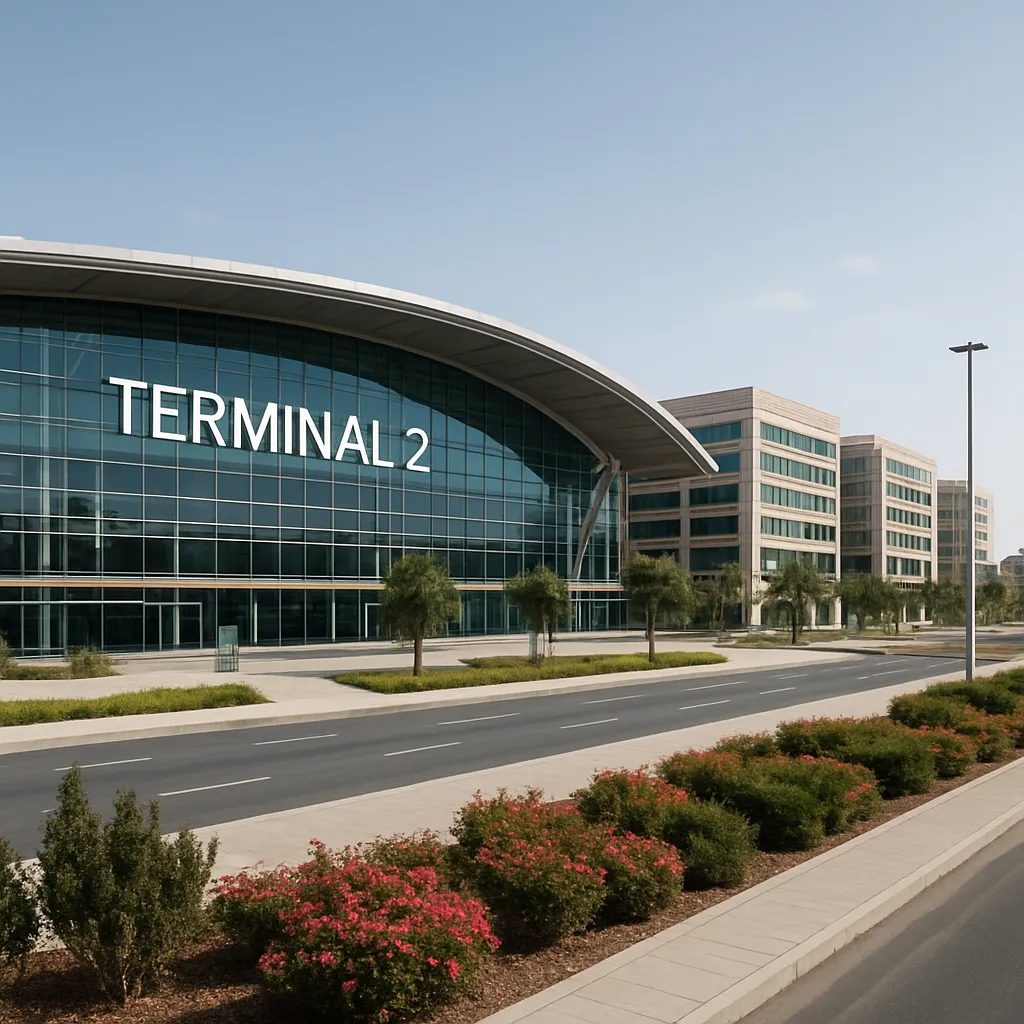
Terminal 2 is a relatively low-rise, utilitarian building compared with the monumental Terminal 3; its architecture reflects function and operational efficiency. The terminal was the subject of a significant refurbishment that modernized arrival and departure halls, improved processing facilities and updated passenger amenities.
Design and passenger flow
- Compact footprint aimed at rapid passenger movement and short walking distances.
- Clear segregation of arrival and departure flows to reduce congestion during peak periods.
- Practical boarding arrangements, often relying on airbridges where available and on bus boarding to remote stands for some operations.
Inside, travelers will find standard airport services: check-in counters, immigration and customs, baggage handling systems, duty-free or retail options (smaller than those in the major terminals), food and beverage outlets, prayer rooms, and basic business-class or pay-in lounges. The terminal also includes operational support spaces: airline offices, ground handling areas and cargo handling sections tailored to the types of services commonly operated from this part of the airport.
Passenger amenities and accessibility
- Improved baggage reclaim and arrivals halls post-refurbishment.
- Family- and passenger-focused facilities such as dedicated prayer areas and quiet spaces.
- Accessible layouts for passengers with reduced mobility; ground transportation options concentrated outside the terminal entrance.
Although the retail and luxury offerings are modest relative to Terminal 3, Terminal 2 provides the essentials needed for comfort and transit. Its operational simplicity can make for a faster, less stressful experience for travelers whose itineraries do not require the extensive shopping and lounge ecosystems of the airport’s larger terminals.
Operations, airlines and typical traffic
Terminal 2 is most often associated with short- to medium-haul operations. It supports a roster of airlines that favor efficiency and rapid turnaround over the premium connectivity offered through Terminal 3. A key feature of the terminal’s operational profile is its suitability for seasonal and charter flights as well as scheduled services.
Airlines operating from Terminal 2 have included a mix of regional carriers and low-cost operators. One national low-cost carrier has used Terminal 2 as a base for many of its operations, and a variety of international carriers serving the Indian subcontinent, Central Asia, and regional Middle Eastern destinations frequently use the facility. Because airline allocations can change over time, the exact list of carriers may vary with operational needs and scheduling patterns.
The terminal is also used periodically for special operations: charter flights for holiday traffic, repatriation missions, and humanitarian or ad hoc services when flexibility is required. During global or regional disruptions, smaller terminals like Terminal 2 often become operationally important because they can be adapted for rapid changes in schedules and passenger flows.
Transport links and passenger connectivity
Connectivity is a core strength for any airport terminal, and Terminal 2 benefits from straightforward access to Dubai’s road network. It is reachable by taxi, private car, and public bus services; dedicated shuttle buses connect Terminal 2 to the airport’s main cluster of terminals, easing transfers between the smaller terminal and the larger transit hubs.
- Road access: Quick access to Airport Road and the network leading into central Dubai and surrounding emirates.
- Public buses and shuttles: Regular services link the terminal with key points in the city and with other terminals at the airport complex.
- Metro connection: Terminal 2 is not directly served by the Dubai Metro; the metro primarily serves Terminals 1 and 3 via dedicated station stops. Transfers to the metro therefore typically require a short road journey or shuttle.
From downtown Dubai, travel time to Terminal 2 by car is typically in the range of 15–25 minutes depending on traffic conditions. For international visitors, the ease of taxi access and the availability of airport shuttles often make transfers to and from Terminal 2 straightforward despite the lack of a direct metro link.
Statistics, capacity and performance
Publicly available statistics for the entire Dubai International Airport illustrate the broader operational context in which Terminal 2 functions. Dubai International is one of the busiest international airports, with passenger traffic peaking at over 86 million passengers in 2019. Such volumes underscore the need for a diversified terminal portfolio that includes smaller, more flexible buildings like Terminal 2.
Specific figures for Terminal 2 are less frequently published in isolation, but industry and airport sources indicate that the refurbishment and modernization efforts increased the terminal’s practical handling capability to accommodate several million passengers annually. An often-cited capacity figure following the upgrade places Terminal 2 at an approximate annual capacity in the range of 4–6 million passengers, depending on airline mix and peak period utilization. This capacity is intentionally modest compared with Terminal 3’s capacity, but it is significant for the kinds of services it supports.
- Approximate post-refurbishment capacity: around 5 million passengers per year (industry estimate).
- Design focus: high-frequency, short-haul operations and charter flights rather than high-volume long-haul throughput.
- Gate and stand configuration: predominantly narrow- and medium-body aircraft parking and remote stands for bus transfers.
Operationally, Terminal 2 contributes to the resilience of the airport system by offering alternative handling space when Terminals 1 or 3 are under pressure. Its ability to absorb charter and seasonal demand helps smooth peak loads across the airport district.
Interesting facts and operational highlights
Terminal 2 may not attract the same attention as Dubai’s flagship Terminal 3, but it has several notable attributes:
- Flexibility: The terminal’s design and operating model make it ideal for quick airline turnarounds, which is attractive to low-cost and charter carriers.
- Rapid refurbishment: The modernization program focused on efficiency gains—upgraded passenger processing, enhanced immigration capacity and improved baggage handling—delivered tangible benefits for daily operations.
- Seasonal role: Terminal 2 is often the terminal of choice during peak holiday seasons, when charter flights to and from holiday destinations increase sharply.
- Training and operations base: Due to its concentrated operations, Terminal 2 has been used as a location for ground handling training exercises and as a pragmatic base for operations that do not require the full-service footprint of larger terminals.
- Operational resilience: In times of demand spikes or when larger terminals are being prepared for expansion or maintenance, Terminal 2 offers a ready alternative for rerouting flights.
In addition to these operational strengths, Terminal 2 has occasionally featured in media coverage when regional airline strategies have shifted, or when the airport has needed to accommodate surges in repatriation and humanitarian flights. Smaller terminals like this can be indispensable during periods when the aviation network needs to reconfigure quickly.
Environmental considerations and service quality
Although Terminal 2 predates many of the most recent sustainability initiatives in aviation infrastructure, airport management has used upgrades to improve energy efficiency, passenger comfort and service quality. Modernized lighting, more efficient HVAC systems, and better passenger flow design contribute to reduced energy usage per processed passenger compared with older pre-refurbishment conditions.
Service quality in a compact terminal can be high because passengers often encounter shorter walking distances and less complex routing between check-in, security, and gates. For travelers who prioritize speed and a straightforward layout over expansive retail and lounge experiences, Terminal 2 typically offers an attractive balance of practicality and comfort.
Future prospects and integration with the airport district
Dubai International Airport continues to evolve, driven by growth in global travel and the emirate’s strategy to remain a central aviation hub. In that context, Terminal 2 is likely to continue serving a specialized role: a nimble, adaptable terminal that supports regional networks and provides operational depth to the airport district.
Potential future developments affecting Terminal 2 could include:
- Further technological upgrades to accelerate passenger processing and automate routine functions.
- Improved inter-terminal connectivity—potentially via enhanced shuttle services or more seamless transfer arrangements—to integrate Terminal 2 more tightly into airport transfer flows.
- Incremental expansions or reconfigurations to address changing airline requirements or to increase capacity during peak seasons.
Any long-term strategic changes at Dubai International Airport—for example, increased runway capacity or new terminals—will influence how Terminal 2 is positioned. For now, its role as a specialized, efficient facility serving regional, low-cost and charter operations remains clear.
Summary and final observations
Dubai Airport Terminal 2 is a purpose-driven piece of airport infrastructure that complements the massive operations at Terminals 1 and 3. Its strengths are flexibility, operational efficiency and a focused offering tailored to short- and medium-haul services. Following modernization efforts, the terminal increased its handling capability and improved passenger amenities while maintaining a pragmatic design ethos that prioritizes speed and convenience.
For travelers, Terminal 2 typically represents a straightforward, no-frills airport experience with essential facilities and easy access to the road network. For airlines and airport planners, it remains a valuable asset for handling seasonal peaks, charter services and a variety of regional connections that underpin Dubai’s status as a global aviation hub.