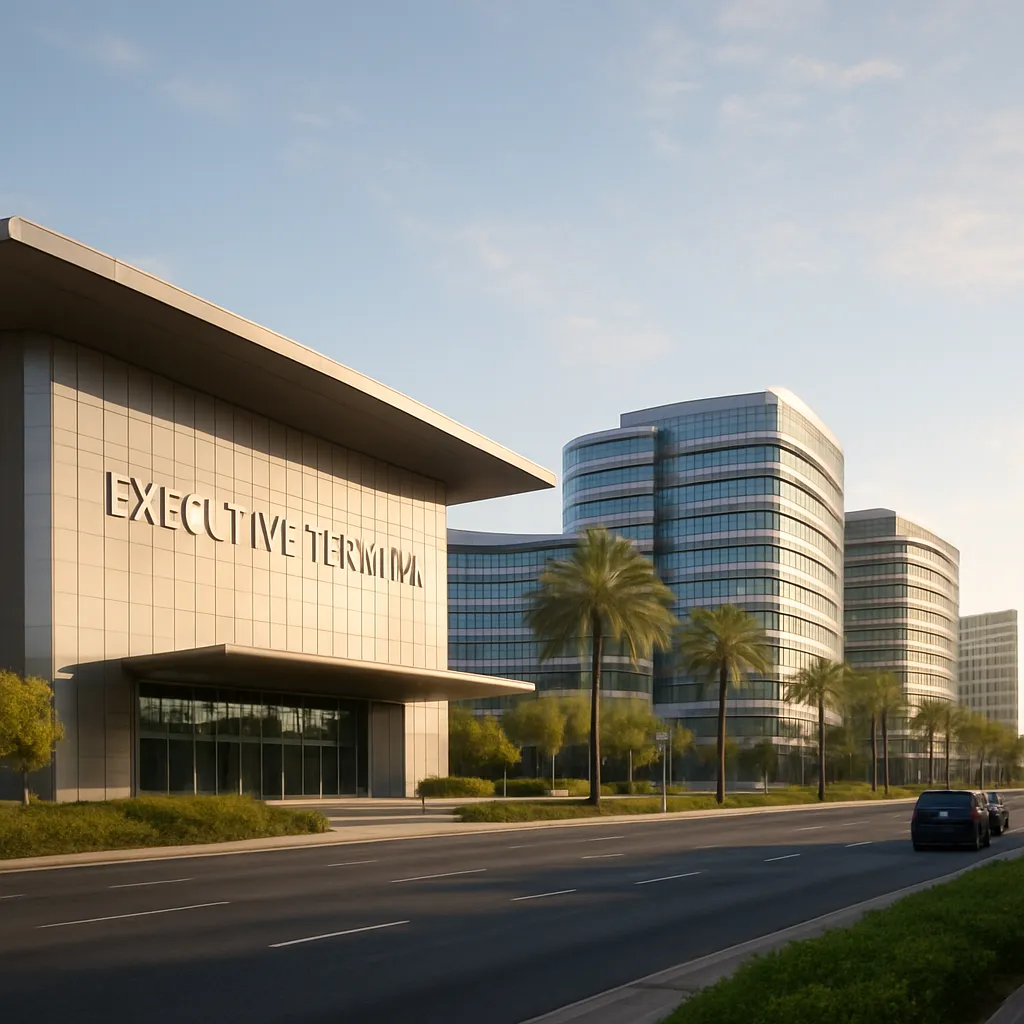
The Executive Terminal serving Dubai’s airport complex is a distinctive piece of aviation infrastructure that blends privacy, speed and luxury for business and governmental travellers. Located within the broader Dubai airport district, these facilities play a crucial role in the city’s position as a global hub for commerce, tourism and international events. This article explores the terminal’s location, design, services, operational role, statistics where available, and the future outlook for executive aviation in Dubai.
Location and Role within the Airport District
The executive aviation facilities in Dubai exist as part of a layered airport ecosystem that includes the main international hub and the growing Dubai World Central complex. Within this structure there are two complementary types of facilities: an on-airport executive terminal that serves business and diplomatic traffic at Dubai International Airport and a purpose-built fixed-base operator (FBO) complex at Al Maktoum International (commonly referred to as DWC or Dubai World Central). Both are designed to meet the needs of private, corporate and state aircraft while keeping them operationally separate from large commercial flows.
The on-airport executive terminal is positioned to offer immediate access to the commercial runways and auxiliary services of Dubai International (commonly abbreviated DXB), enabling ultra-fast transfers for high-profile passengers who require discrete handling and expedited border formalities. The DWC-based facility, in contrast, sits within the sprawling Dubai World Central masterplan and is optimized for long-term growth of business aviation, aircraft maintenance, and dedicated hangarage.
Together these facilities contribute to Dubai’s strategic aim to provide world-class connectivity for corporate aviation, aligning with the emirate’s economic development objectives and its ambition to be a global meeting place for commerce, finance and tourism.
Design, Architecture and Facilities
Executive aviation terminals in Dubai are designed with a clear focus on privacy, efficiency and high-end comfort. Architects and operators aim to minimize the time passengers spend in transit and maximize the quality of their experience.
Building layout and passenger flow
- Separate arrival and departure areas that allow direct transfer from vehicle to aircraft.
- Private check-in counters and security lanes to ensure rapid processing and minimal queues.
- Dedicated immigration and customs facilities, often with priority lanes for diplomatic and VIP clearances.
- Wide, open lounges with meeting rooms that can be configured for briefings or private receptions.
Key amenities
- Luxurious lounges and private suites with high-end finishes and advanced AV systems.
- On-site crew rest rooms and planning areas.
- Concierge and ground transport coordination, including limousine, helicopter and armored transport options.
- Full FBO services: fueling, de-icing (where required), ground power, catering and cabin provisioning.
- Advanced ground handling and quick-turn capabilities to support short turnaround windows.
- Hangars and maintenance facilities capable of accommodating light to large business jets.
Many executive terminals in Dubai are designed to convey a strong sense of place through the use of regional materials, contemporary Arabic design motifs, and landscaping that provides privacy and shade. Interiors often prioritize acoustic isolation, high-quality finishes, and abundant natural light to create a calm environment for busy travellers.
Operations, Services and Security
The operational model for Dubai’s executive terminals is tailored for discrete, rapid and reliable service. For operators, the emphasis is on minimizing friction: seamless transfers, predictable slot coordination, and a single point of contact for ground services.
Fixed-Base Operator (FBO) services
- Aircraft handling and parking coordination for a wide range of business aviation types, from light turboprops to large-cabin VIP jets.
- Refuelling services compliant with international safety and quality standards.
- Specialized ground support equipment and technical support teams for routine servicing and pre-flight checks.
Security and diplomatic handling
Because the executive terminals commonly handle heads of state, corporate leaders and high-net-worth individuals, security protocols are robust and multi-layered. These may include background-checked staff, controlled access areas, secure transportation corridors, armored vehicle parking, and liaison with national security services for delegations requiring additional protection. The efficient handling of diplomatic clearances is a regular operational task, enabling visiting heads of state to move quickly and securely between their aircraft and secure vehicles.
Concierge and value-added services
Beyond the basics, executive terminals provide a wide spectrum of concierge services: bespoke catering from Michelin-level suppliers, art and cultural requests, customized ground transport solutions, business centre facilities, and event hosting for delegations. These services are intended to create a seamless executive experience where time is the premium commodity.
Statistical Context and Economic Impact
Executive terminals contribute to the overall economic footprint of Dubai’s aviation sector by facilitating business travel, supporting international trade delegations, and enabling private aircraft operations that often generate high levels of local spend (catering, ground services, maintenance, and accommodation).
To place executive operations in context: Dubai International Airport handled approximately 86 million passengers in 2019, ranking it among the busiest airports in the world for international passenger traffic. While the bulk of those passengers travel on scheduled commercial flights, the activity generated by private and corporate aviation is significant in terms of economic value per passenger. Business aviation users typically spend more per visit on hospitality, accommodation, and support services compared with average commercial travellers.
Specific statistics for executive terminals are often not published in the same detail as commercial terminal figures, but some general observations apply:
- Business and general aviation movements represent a small percentage of total flights, but they can account for disproportionate revenue through premium services and ancillary activities.
- Hangar space rental, maintenance contracts and FBO services are important revenue streams for airport operators and private service providers.
- Major events in Dubai—such as the Dubai Airshow, Expo-class exhibitions and international summits—produce spikes in executive movements and generate additional seasonal demand for these terminals.
Notable Uses, Events and Reputation
Dubai’s executive terminals have become synonymous with fast, discreet and luxurious travel. Their user base typically includes corporate executives, entrepreneurs, entertainment and sports figures, diplomats and government delegations. Several notable use-cases illustrate their role:
- Diplomatic and government flights: enabling quick, private entry and exit for state visits and official delegations.
- Corporate rotations: high-frequency business travellers using on-demand jets for intra-region connectivity.
- Event-driven surges: during major trade shows and expos, private traffic increases as exhibitors and VIPs arrive on bespoke charters.
- Medical and emergency flights: rapid handling for medical evacuation or specialized charter missions.
Because of Dubai’s global profile and the high concentration of international business in the emirate, the executive terminals are regularly used by delegations and high-profile visitors. The discretion and efficiency of these facilities contribute to Dubai’s reputation as a preferred meeting point for cross-border negotiation and high-level diplomacy.
Integration with Ground Transport and Urban Access
Executive terminals are designed not only for airside efficiency but also for excellent ground connectivity. Ground access planning emphasizes time savings and privacy:
- Private driveways and dedicated pick-up/drop-off zones allow vehicles to approach the terminal without passing through public areas.
- Proximity to major highways reduces transit times to central business districts and key hotels.
- Helipads and helibase arrangements are often available or negotiable for guests who prefer rotor transfers to city-centre heliports or offshore facilities.
- Liaison with limousine services, chauffeur companies and armored transport providers ensures customised transfer solutions.
This level of integration is essential in a city where executives frequently move between business meetings in multiple emirates or need rapid access to international connections.
Operational Challenges and Best Practices
Running an executive terminal in a major hub presents a particular set of operational challenges. Managing expectations for speed and privacy while maintaining safety, regulatory compliance and cost-efficiency requires strict processes and robust infrastructure.
- Slot coordination: Aligning private movements with busy runway slots at DXB requires careful coordination with air traffic services to avoid delays.
- Security posture: Balancing the need for high security with the desire for privacy can be complex and necessitates well-defined protocols.
- Resource availability: Ensuring adequate ground handling staff, fueling capacity and catering resources during peak events is critical to maintain service levels.
- Compliance and licensing: FBOs and terminal operators must adhere to aviation regulations, customs and immigration rules, and local labour laws.
Operators mitigate these challenges through robust staffing models, advance planning for peak periods, and strong partnerships with airport authorities and government agencies.
Future Developments, Sustainability and Innovation
Looking ahead, executive aviation in Dubai is likely to pursue growth shaped by sustainability goals, technology adoption and evolving customer expectations. Several trends are already influencing strategic planning:
Decarbonization and fuel alternatives
Industry-wide pressure to reduce carbon emissions is driving interest in sustainable aviation fuels (SAF), hybrid propulsion technologies and operational measures that lower fuel burn. Executive operators and FBOs in Dubai are exploring SAF supply chains and efficiency programs to reduce the environmental footprint of private flights.
Digitalization and customer experience
Investment in digital tools—such as advanced flight planning platforms, e-immigration pre-clearance, mobile-based concierge services and real-time apron management systems—improves predictability and shortens turn-around times. Customers increasingly expect smartphone-enabled, frictionless service from booking to boarding.
Infrastructure growth
As demand for private aviation grows in the Middle East, additional hangar capacity, larger apron areas and expanded terminal facilities are likely to be developed at both DXB-linked executive sites and at DWC. The long-term masterplans for Dubai World Central envisage significant capacity increases for passenger and cargo movements; within that framework, executive aviation infrastructure will continue to expand.
Quality and safety standards
Maintaining world-class safety and service standards remains a priority. Continued investments in staff training, emergency response capabilities and facilities upgrades are expected as operators compete on quality and regulatory compliance.
Interesting Facts and Lesser-Known Details
- Executive terminals commonly include dedicated spaces where flight crews can rest, brief and plan while passengers remain in private lounges—this separation of passenger and crew flows is a hallmark of FBO operations.
- In many cases, the furnishings and art within these terminals are curated to a level found in boutique hotels, reflecting the expectations of high-net-worth clientele.
- Because of Dubai’s extreme summer temperatures, apron and hangar operations often incorporate shaded and cooled areas for passengers and aircraft systems—for example, covered walkways and climate-controlled ramp vehicles.
- Some executive terminals can arrange for transient aircraft to be repositioned overnight to optimize slot availability and reduce on-the-ground time during peak periods.
Conclusion
Dubai’s executive aviation terminals occupy an important niche within the emirate’s broader aviation strategy: they offer privacy, speed and premium service for a clientele that values time and discretion. Whether operating from a dedicated on-airport executive terminal near the runways of DXB or from the expansive DWC complex at Al Maktoum, these facilities combine sophisticated logistics, luxurious amenities and rigorous security to support diplomatic missions, corporate travel and high-value tourism. As Dubai continues to grow as a global hub, the role of the executive terminal and associated FBO services will remain central to the city’s ability to attract elite events, business delegations and international investment, while adapting to future demands for sustainability and digital convenience.